What is your corporation really doing to you? And what are you doing to it?

Michael Lewis, ridiculously excellent author of Moneyball and Liar’s Poker has written an excellent column for Business Insider that examines the consequences of people who join the finance industry, only to be altered profoundly and negatively by the experience:

The question I’ve always had about this army of young people with seemingly endless career options who wind up in finance is: What happens next to them? People like to think they have a “character,” and that this character of theirs will endure, no matter the situation. It’s not really so. People are vulnerable to the incentives of their environment, and often the best a person can do, if he wants to behave in a certain manner, is to choose carefully the environment that will go to work on his character.

Just so you know the lens through which I read the article, I don’t think that we’re significantly compelled by our genetics to behave in certain ways. Yes, genetics have an effect, but since you can shape and change your genetic make-up as you live, I’ve always thought that (to quote a quite brilliant Economist ad – you remember them – by the equally brilliant Tim Riley) it’s Nature vs Nurture: away win.

So the idea that a somewhat well-intentioned person might enter the lion’s den of global finance and not be changed (damaged?) by it seems to me unlikely. But how does that happen, and is it happening in your industry?

Mr Lewis’s article gives some disturbing and thought-provoking reasons for the effect that occurs in the financial sector, but one in particular seemed an interesting corollary to the insidious nature of many of today’s giant corporations:

The people who work inside the big Wall Street firms have no serious stake in the long-term fates of their firms. If the place blows up they can always do what they are doing at some other firm — so long as they have maintained their stature in their market. The quickest way to lose that stature is to alienate the other people in it. When you see others in your market doing stuff at the expense of the broader society, your first reaction, at least early in your career, might be to call them out, but your considered reaction will be to keep mum about it. And when you see people making money in your market off some broken piece of internal machinery — say, gameable ratings companies, or riggable stock exchanges, or manipulable benchmarks — you will feel pressure not to fix the problem, but to exploit it.

So do you love the agency you work for?

And would you care if your agency went bust tomorrow if you had already secured a good job elsewhere?

And would that caring be down to anything other than the fact that your friends would lose their jobs and therefore find the near future somewhat difficult?

I’ve loved many places I’ve worked at, including the current one, but I’ve also seen how large corporations can suddenly decide that its employees are expendable. And what does that do to people? It makes them care less about the corporations they work for and makes them concentrate much more on what’s in it for them.

In the above Lewis paragraph you can swap ‘gameable ratings companies’, or ‘riggable stock exchanges’ for scam ads and many staff not giving a shit about whether an ad shifts product so long as they get a big client on their CV or work with an edgy director.

As many of you saw in the David Abbott memo I posted last week, some companies used to have an ethos that people could stand behind, a North Star that could guide every difficult decision. Now the North Star is more often than not the generation of cash, and it’s hard to swallow being called in to work late nights or weekends so that Martin Sorrell’s Cannes yacht has enough fuel to move another 500 yards.

But no one comes into any industry to be thusly jaded. It happens because your surroundings shape you, minute by minute, millimetre by millimetre, and by the time it’s bent you out of the shape you wanted to be, it often feels like it’s too late, and that’s to the corporation’s detriment as well as your own.

But does it really matter?

Yes it does, because it reduces the chances of you or your corporation realising your possibilities.

You create your company and your company creates you. You create your circumstances and your circumstances create you. It’s kind of chicken and egg, but it’s always going to be within your power to make the most of the situation in which you find yourself. You can be a fluffier chicken or a tastier egg. Don’t be shaped by something that doesn’t work for you. Shape it back until you have the context that speeds you on to your possibility.

You have nothing to lose but the shitty life you never wanted.



worst endline I’ve seen in a while

IMG_5415 (Apologies for slight distortion of image. Click on it for greater clarity.)

Expensive, glamorous product shot? Check.

Decent-sized, tasteful logo? Check.

Company known by everyone who’s into fashion? Check.

Dismal, punny, unnecessary endline that ruins the entire ad? CHECK!


I can take a phrase that’s rarely heard, flip it, now it’s the weekend

What it takes to be a London cabbie (thanks, D).

So much fun.

How the music of Pulp Fiction happened (thanks, A).

Soderbergh messes with Raiders of the Lost Ark.

Fun addictive colour game (thanks, P).

Questionable kids’ books (thanks, J).

How did Robert Zemeckis film the opening of Back to the Future?

Slow motion tattooing:

David Fincher interview.

Oh, what fee-eeling, when you’re dancing on a… wall:

Panorama photo fails.

The fascinating story of how The Shawshank Redemption came about.


The real Jiminy Glick is dead

I don’t know when I first became aware of Jiminy Glick, but I do recall I used to weep with laughter at whatever JG clips I could find back in the early 2000s:

If you enjoy his work as much as I do there are plenty more clips on YouTube

Anyway, I hadn’t thought of Jiminy in a while, but then I discovered that the man he was based on has just died. Apparently a guy called Skip E. Lowe used to interview people like Orson Welles, Bette Davis and Tony Curtis in school community centres using his own equipment. How very odd:

https://www.youtube.com/watch?v=DMYz-snQrWI


Being poor seems like a right arse

I’m not poor and I never have been.

The closest I’ve come to the breadline were those times at school or university when my pocket money, or Prêt a Manger wages, couldn’t stretch to another comic or pint.

So I’ve been very fortunate that I’ve never felt hunger that I couldn’t quell by choice; I’ve only received final demands because I wanted to go to the movies when the earlier bill came in; my kids have always been fed, clothed and allowed to experience all the books and toys they could wish for.

Lucky me.

But I’ve always had this nagging feeling that my circumstances have not quite been available for everyone else. Those less well-off than me seemed to fill up Camden High Street every Saturday afternoon, but I walked past them with only the slightest idea of who they might be or why their trainers didn’t have a logo on the side. Yes, I regularly give £20/$20 notes to the homeless (my version of trickle down economics), but I’ve never really considered how they got there, or how difficult they might find it to change their situation.

Which is why I felt privileged to read this article. It’s a fantastic piece, written by a lady who has experienced the numbing, debilitating grip of everyday poverty. She’s not complaining; she’s just laying out the realities of how and why she, and millions like her, live the way they live.

Coincidentally it turned up in my Twitter feed around the same time as this:

Now, I’m not saying we should react as Russell Brand does, but if you’d like a perspective into the way many people regard the poor in western society, watch the Fox News parts of that clip.

Where am I heading with this post? Down a cul-de-sac, really; I don’t know what to do to really help, especially when the ever-expanding range of problems currently faced by society is paralysingly colossal. But I just thought I’d put this stuff out there. Maybe you have a solution that you could share with us, or maybe you’ll feel a bit more generous next time you walk past or talk about a person who is not as well-off as you are.

Meanwhile, come on the guy who waits by the traffic light at Laurel Canyon Blvd; I have a $20 bill just for you.


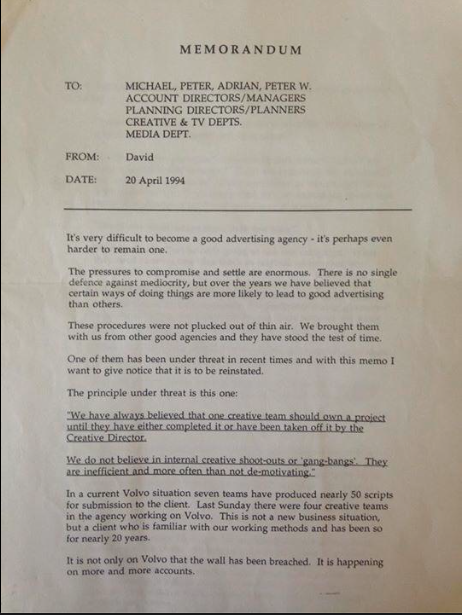
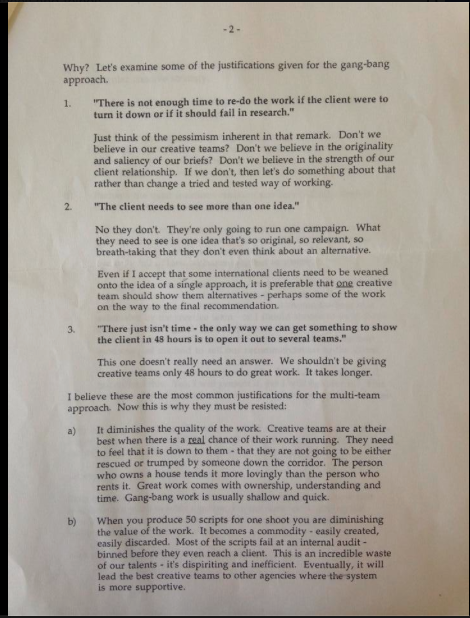
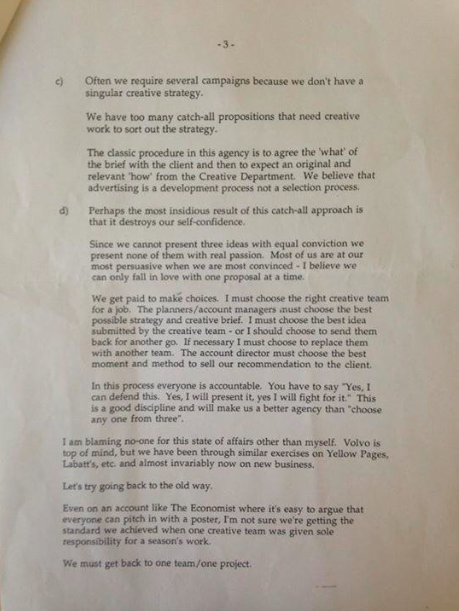
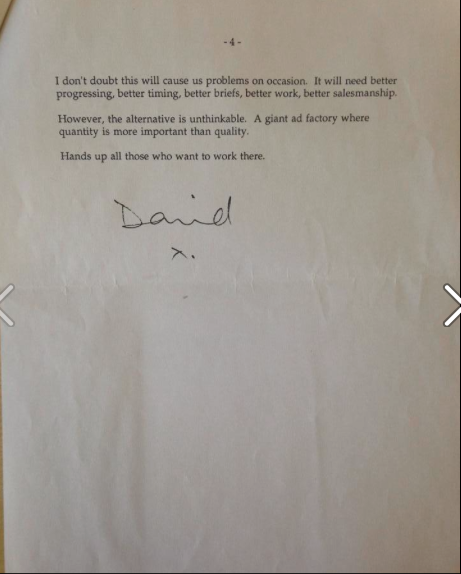
Probably the best advertising memo ever written

Screen Shot 2014-09-22 at 20.46.58

Screen Shot 2014-09-22 at 20.48.34

Screen Shot 2014-09-22 at 20.48.54

Screen Shot 2014-09-22 at 20.49.07

(Via Shaheed @ The Creative Floor.)

I’ll just add that when I arrived at AMV in 1998 it was still one team one brief (in contrast to my previous agency, Y&R, where it was as David describes above). I was amazed and delighted for all those reasons.

It worked very well until it changed.


Fucking brilliant

https://www.youtube.com/watch?v=q__1WF9aLY4


Quirky ad reminds me of the quirky ads from around 2002 -in a good way.


On paper vs on the air

I f you’re an advertising creative (or a scriptwriter of some sort), you will at some point have to produce an ‘idea’ on a piece of a paper, which is then intended to convince lots of clever people that it would be a good TV ad.

So far so obvious, but the process of how a ‘good’ script becomes a good or bad ad, or how a so-so script can become something great is rarely discussed.

I’m aware of a script that said as little as ‘People rub themselves in Levi’s jeans’ that was not only approved all the way up the chain at BBH, but was also taken on by Frank Budgen and shot (here’s the result). I don’t think that script made a classic Levi’s ad, despite the fact that it was Fred and Farid + BBH + Levi’s (when they made excellent ads) + Frank in his prime. But was it a good script? Was the massive free rein the right thing to do? Or was it actually a bit crap and lazy, resulting in an ad to which you could apply similar adjectives?

I heard recently that the same thing happened for a classic Orange ad in its early WCRS days: ‘Just shoot some kites’. I seem to remember that a VO went alongside that, elevating it from the dullness of 60 seconds of nicely-shot kites, but maybe that was a good brief to give a ‘visual’ director. Plenty of ads have no real narrative, so why pretend to have one when you don’t?

Then again, what about great scripts that have produced poor ads? They’re harder to come by, obviously, but I’ve definitely heard the phrase ‘every director in town is after this one’, or ‘Frank’s pitching against Danny’, only to see a rather underwhelming 60 seconds at the end of the process.

Of course, many things can go wrong (or not right) during the process, leaving your ad without the great track, cast member or editor who might otherwise have sprinkled the requisite fairy dust over the production. And the opposite can happen, with a brilliantly chosen bed of sound design or series of beautifully-lit shots elevating something that would otherwise have been humdrum. But at the end of the day you have to fill a sheet of A4 with the right words to get your ECD interested, the client to put his hand in his pocket and the production bods excited enough to take it on and bring their A game. Without that you don’t even get the chance to beef it up/fuck it up with the later decisions.

So have you been surprised by your own B- script turning into an A+ ad? Or vice versa? Have you seen the shiteness of others become miraculously brilliant because you weren’t able to see the hidden diamond that only a great ECD or director could spot? Have you watched an ad on TV, considered the script it must have come from, and thought ‘how the fuck did that ever get made’?

Open on a slightly bored creative, scratching his head…


We left you in pastures rarely seen (holding out the fortress for a while). Everyone knew why the calm had been (keeping friends among you saves a fight). In the dead of the night there was the weekend.

What it’s really like casting Bill Murray (thanks, J).

Best screenwriting blogs (thanks, J).

And the best screenwriting books (thanks, J).

More great books (thanks, M).

Upside-down portraits that look like aliens (thanks, A).

Kanye orchestrates:

Stephen King interview.

YOLO 2 (thanks, J):

Film data (thanks, J).

The homeless Casanova (thanks, J):

Watch this guy race a tube train (thanks, J):

So much great North By Northwest stuff.

Rush Hour (thanks, J):

Nerd raps in the hood (thanks, J):

Improve your Netflix queue (thanks, J).

Art we can all appreciate (thanks, Y).

An app that fills a hole in the quantified self (thanks, H/M).