Category: Uncategorized

Stephen fry/grown-ups

I’ve just finished The Fry Chronicles. It’s an entertaining read, hampered somewhat by Mr. Fry’s tendency  to go on and on and on about how crushingly insecure he felt even when he was the toast of Cambridge/The West End/Broadway etc. Yes, Stephen, we get the point: you need to be somewhat self-deprecating about your achievements, but one explanation of that would be plenty.

Anyway, as I tend to do when reading books of this kind, I marked a couple of passages (so did Stephen) that might interest you:

‘Novelty and originality do not come from the invention of new milieus, new genres or modalities. They come from the how and the who, not the what’.

Another dig at digivangelism. ‘Nuff said. But then we have a slightly more interesting point:

‘Intoxicating drinks disguised as milkshakes and soda pops exist for those whose taste buds haven’t grown up enough to enjoy the taste of alcohol. As in food so in the wider culture. Anything astringent, savoury, sharp, complex, ambiguous and difficult is ignored in favour of the colourful, the sweet, the hollow and the simple.’

Have you noticed how many ads, especially those aimed at adults, seem to be full of exactly the kind of thing Stephen is talking about? Cartoon characters, primary colours, dumbass soundtracks and fuckbrained, educationally subnormal voiceovers that seem tailor made for children or morons.

I guess people will justify this by saying that such pappy blancmange is more likely to appeal to more people, but to what extent? Darker, more polarising, more ambiguous ads are far rarer, but also far more memorable:

http://www.youtube.com/watch?v=_9HX5Eou6U8&feature=PlayList&p=8F3DCB207BB5D163&index=0

Why don’t adults who are talking to other adults produce work that is more, well, adult?

Instead of aiming for the lowest common denominator, why not try appealing to grown-ups with brains?

If movies aimed at kids can take a chance on something like this:

http://www.youtube.com/watch?v=o1e26efPnUY

why can’t ads aimed at grown ups?


Chance favours the connected mind

Or, where do good ideas come from:


We Kend

Video Essay on David Fincher’s title sequences.

Don’t freerun (Thanks, M.)

Video essay on the nature of theft vs inspiration, with plenty of Zeppelin.


The A-list

Every year Campaign sends a questionnaire to some people that they consider to be the most significant in the land we call ad.

If you’d like to pretend you are one of them, here are this year’s questions, with one red herring that I popped in for a ‘laugh’. Can you spot it?

First name:

Last Name:

Company:

Job Title:

Work Phone:

Work e-mail:

When and where were you born:

What are your favourite media (including TV programme, newspaper, magazine, website):

What is your favourite app:

What would be your idea next job:

What’s your favourite ad campaign from this year:

When did you last snort a fucking fat line of charlie at an awards do:

Who are your three best friends in adland:

Who (in the industry) do you owe most to for your success and why:

Why do people like you:

What’s your greatest extravagance:

What (apart from children) is your greatest achievement:

What’s your idea of perfect happiness:

What do you think will be the biggest change in advertising over the next five years:

Dunno about you, but to me those seem like quite dull questions.

Do you have any better? Of course you do. That’s what the comments section is for.


Sorry. This one’s a bit dull.

Thinking about Sunday’s post, I’ve come to a few conclusions that seem to have thrown up more questions than I would like.

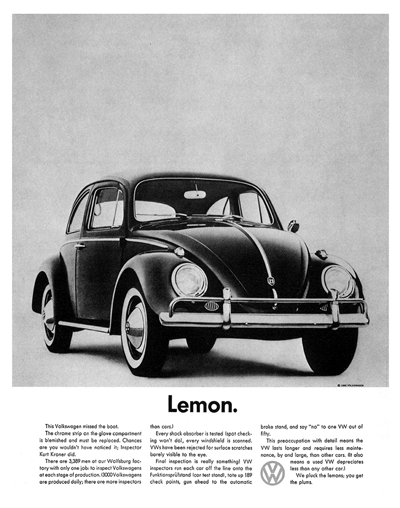
1. As commenter ‘Paul’ pointed out, there were holes in my assertion through which a Sherman Tank could be driven. There are plenty of ads now that are as good, in their own way, as Lemon.

2. But plenty are far worse, so if advertising doesn’t improve uniformly, that just makes it like many other art forms. Unlike science, where you build on each piece of knowledge until it becomes obsolete, the development of art creates ‘new’ and ‘different’, but whether either of those two words denote ‘better’, is a matter of opinion. I believe ads like ‘Lemon’ would be considered brilliant today, but much of what was produced 50 years ago would not, and that’s just like movies (Renoir, Kurosawa, Hawks=great; thousands of other films from their era-shite), books, art etc.

3. Perhaps the improvement of ads is more like evolution, where the obsolete is discarded as the form seeks to fit its current time. Sure, we still have press ads, but the starburst has long since disappeared (pretty much).

4. But then there’s the relentless search for the new. Does that lead to viable styles and techniques being cast aside before their time? Or is this neophilia a result and perpetuation of the need for originality?

Hmmm…


You might enjoy the new OK Go video

(Thansk, G.)

The first one to say that these videos do a great job of distracting from their music gets a small cuddly toy.


I think lots of important american creatives read my ‘you need an out’ post.

In one way or another, they’re all getting out.

(Thanks, V.)

By the way, that V is Vinnie of The Escape Pod (how apposite is that name?). His post on this is much better than mine (how could it be worse?) because it points to where this event might lead us.

As I said in a comment on his blog, could this be the tipping point that leads advertising back to being the fun industry that most of us wanted to get into?

Of course, the big networks will still survive, and with the money they have behind them they will be able to attract a certain degree of talent, but it’ll be interesting to see how this affects things.


I know I’m a bit late to this…

But it’s a thing of massive beauty:

http://www.youtube.com/watch?v=DKRlWLDWhGI

(Thanks, A.)


Something on the shoulder of giants

I’ve seen a fantastic ad that cuts through the usual shit with a remarkably incisive, confident, friendly way of pointing out a product benefit and getting you to like the brand and the product behind it.

It treats you with respect and manages to engage you in a ‘conversation’ that is somehow invisible.

Crazy, I know, but it is written so skillfully, it presents only one side of the dialogue, yet manages to elicit a response from the reader all the way through it. That response is like being gently led somewhere you had no intention of going to, but with your willingness to make the journey increasing with every word.

And how clever is that? It’s going beyond all the ‘would you like to join a bunch of people who are happy to admit publicly that they like Vimto?’ digital bullshit and instead engaging by using nothing but a piece of paper and 100 or so words.

The other great thing is that instead of relying on ridiculous over-dramatisation of a slight or non-existent product benefit, it simply lays out the truth with intelligent self-deprecation.

It’s just a shame that even with all the tools of 2010 at our disposal, nobody comes anywhere near to producing work of this quality.

It’s as if we’ve been given the chance to stand on the shoulders of giants and instead, squatted down over the oversized scapulae and curled out something moist, brown and smelly.


One last thing for the weekend

(Thanks, W.)