Category: Uncategorized

Let’s talk about work

I’m currently reading the classic book Working by Studs Turkel (the first book in our agency book club. Hey! Why not start an agency book club?). It’s a series of testimonials from people about their different jobs and the nature of work in general. The first chapter has this quote from a steelworker:

“You’re doing this manual labour and you know that technology can do it. (Laughs). Let’s face it, a machine can do the work of a man; otherwise they wouldn’t have space probes. Why can we send a rocket ship that’s unmanned and yet send a man into a steel mill to do a mule’s work?”

I also read this interview with US comedian Aziz Ansari where he extolled the benefits of not working super-hard:

“I waste an hour or two every day looking at mindless stuff on the Internet. I go down a wormhole from Google News or The New York Times. I’ll watch movie trailers and stuff like that. It’s like, ‘A 15-second video on Instagram of a guy with a light saber! Look at that!’ But I wrote a bit about that, so it did help in that way.”

An hour later I came across this article in US GQ, which explored the jobs which earned the most money for the least effort:

“For many people, work means late nights in the office and even later emails from your boss. A Gallup poll from last year that the average full-time American employee works 47 hours a week, with 18 percent of them working at least 60 hours. Eighty percent of American workers report feeling stressed out at work, according to a Nielsen study from last year. (Wage growth, in case you were wondering, has pretty much been stagnant since 1979).”

And then this article about pointless long hours in NY Magazine:

“This is a version of something psychologists call the “labor illusion,” which, as Burkeman explains, means that although “we might say we’re focused only on whether [someone] did the job quickly and well … really we want to feel they wore themselves out for us.” 

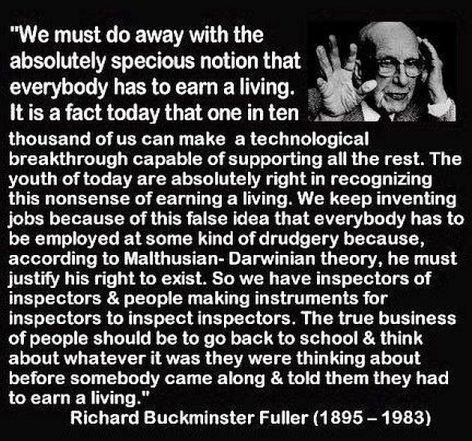
Then a friend of mine posted this quote to Facebook:

richard-buckminster-fuller-we-must-do-away-with-the

This Daily Mash article: ‘Business goes under as entire staff masters art of looking busy’.

So what is ‘work’ in 2015?

What does your day look like? How much of it is Facebook/Twitter/Blogs and how much is actual application to the tasks in hand?

Do you justify Facebook etc. as sponging stuff into your brain so you can be more creative in future?

Or do you give zero fucks?

Is your output a reasonable return for the money you get paid?

Do you enjoy what you do despite the fact that it’s tainted with the pejorative nomenclature ‘work’?

Are we conditioned to dislike working because it’s drummed into us at school to be some kind of ‘necessary’ drudgery that needs to be completed before we enjoy ourselves, like eating your greens before you’re allowed pudding?

Are white collar jobs a bit pathetic compared to the real work of digging roads etc?

Is manual labour basically a stress-free, thoughtless mental holiday that’s far more appealing than pushing a pen (if only it paid more)? (By the way, when my wife worked at a production company she told me that the boss often fantasised about working on a checkout, mindlessly passing barcodes over the electronic reader.)

Is it true, as Churchill said, that if you find a job you like you’ll never work a day in your life?

Do you suspect that there’s really only enough proper work for, say, 500m of us, with the rest doing silly made-up jobs that don’t matter in the least?

I wonder how many hours of actual ‘work’ I do each day. I answer emails, have quite a few meetings and reviews, get on calls with far-flung countries, think about what I could do to make the workplace better in general etc., but how many minutes do I spend doing that? How many is it possible to spend utterly dedicated to those tasks? I like to pop over to Facebook or Twitter occasionally to give my brain a rest and/or find those fascinating little tidbits you all enjoy in my weekend posts, but I don’t really switch off as I continue to think about aspects of the job throughout the day and at at home.

My job spans many time zones, so there’s always someone awake to prod me with an electronic message.I usually wake up to 40 emails and estimate that I receive another couple of hundred throughout the day. I can often go the loo with all messages cleared and return to find a little number 17 in my unanswered mails indicator. But lots of these just have me looped into a conversation between other people. If I had to give a considered response to each one I don’t think I’d have time to do anything else.

However, when I get to the weekend I tend to switch off. The kids are around and they need my attention (and I want to give it to them). I think that’s valuable time and I rarely feel like there’s something else my brain should be occupied with.

I also suppose that there are people in the office who spend more of their hours contributing to the agency than I do, but there are also plenty who spend fewer. But what is the quality of those hours? Is one of mine equivalent to three of a more junior person? Or equivalent to half an hour of my boss’s time? And, as I ultimately contribute to Apple, does my work generate more money than those who work for smaller companies?

In the end it’s just another area of life that human beings guess at with little accuracy. We fit vaguely into out little slots and that seems to be sufficient for the whole situation to continue.

Then we die, and just before that happens we realise that none of it actually mattered at all (smiley face made out of punctuation, perhaps with a wink and a sticky-out tongue).


Swept New York a glancing kiss to those who claim they know. To know the shrieks the seaman hears the devil is in the weekend.

Jeff Bridges interviews Roger Deakins (thanks, J).

Classic Viz letterbocks (thanks, G).

Ten masters of the art form discuss filmmaking. Includes this comencement speech from John Lasseter:

https://www.youtube.com/watch?t=1333&v=tZ8I0NsfmCQ

Have you ever taken the Myers briggs test? Apparently it’s bullshit.

The 5-hour version of Apocalypse Now, anyone?

Tarantino interviewed by Brett Easton Ellis.

Some of these 53 things that thrill British people are rather nice (thanks, T).

And some very funny British tweets (thanks, D).

Little Spermaid? 21 Hump Street? Porn versions of proper movies.

Wildlife photographer of the year.

How to cut a cake properly (thanks, L):

Somewhat related: the scientific way to find Wally/Waldo (thanks, J).

Stunning collection of Pantone, 271 years before Pantone (thanks, D).

Slapdash supercars (thanks, J).

Bach’s Prelude Number One played with boomwhackers (thanks, G):

‘You’re a bagel, a French bagel!” (Thanks, G):

And some brilliant shit tattoos (thanks, G).

Beautiful horror film posters (thanks, J).


If McDonald’s advertised like an Apple Keynote


‘Awards are stupid’

https://www.youtube.com/watch?v=8u-dxn8IgQo

(Thanks, Jon.)

Are they?

In this instance I’m talking about awards that are a matter of opinion, rather than a matter of fact: Oscars, Grammys, Cannes Lions, Sports Personality of the Year, Rear of the Year, BAFTAs etc.

Well, let’s take a look at the supposed pros and cons:

Pros

They serve to stimulate. In theory, other people who work in the industry being awarded see what gets the awards and it inspires them to greater heights in their own work.

They publicise the industry and work concerned, so that perhaps more people will be interested in becoming musicians, ‘rears’ etc. This grows the talent pool for future ‘better’ work.

They generate money for some people. For example, the advertising revenue created by the Oscars ceremony keeps the Academy of Motion Picture Arts and Sciences going all year.

Award dos are fun.

To many people they are proof that the awarded people are good at what they do, and therefore worthy of employment.

Cons

The idea that matters of opinion become matters of fact (eg: the winner of the Oscar for Best Screenplay is considered by many to be the best screenplay of that year) closes off avenues of creativity. People who are inspired by these works then believe that such work is what they should aspire to, leading to a repetition of the winning work rather than actual innovation. There is definitely an ‘Oscar’ type of film and, I would argue, a typical Cannes Grand Prix winner, which can only be a symptom of the dead hand of familiarity guiding the judges’ decisions

They clearly don’t lead to better work. Are the movies of the last ten years better than those of the Seventies? What about the music? Are ads better now than they ever have been? Of course not. So even with shoulders of giants to stand on and millions of awards to inspire us, the improvement is virtually non-existant.

Most are a thin, pointless sham, with no intrinsic value, and therefore a waste of money. Add up all the award entries and event organisations across the world and you have billions that could be better spent on feeding the starving or building the giant ark we’re all going to need when the Polar ice caps melt.

They have an importance that takes precedence over what the art is attempting to achieve. Call me cynical, but I have a feeling that some advertising creatives would rather win awards (ie, have the approval of seven people a bit like themselves) than have a 10% increase in sales (ie change the behaviour of millions). I also have a feeling people (possibly including Anthea Turner) have deliberately performed buttock-enhancing exercises to improve their chances of winning Rear of the Year. Both are sad states of affairs.

So what do you think?

Are awards a GOOD THING or a SHIT THING? (No comments suggesting they’re a bit of both/somewhere in between please.)


You are my fire. The one desire. Believe when I say, I want the weekend.

We like long build ups and disappointing drops (thanks, H):

The Miles Davis door (thanks, F):

This guy is happy to admit he doesn’t ‘get’ art (thanks, T).

Watch food being digested:

Marvellous Scottish humour (thanks, T).

Mash up by a director to introduce himself at a film festival (thanks, J):

Van Damme’s Kills (takes half an hour; thanks, J):

Dad jokes a-plenty (thanks, J).

This is funny:

https://www.youtube.com/watch?v=nKD5pKzzXvU&feature=youtu.be

Accidental vajayjay (thanks, T2).


A fine, fine ad


Someone asked me if I’d heard any interesting podcasts recently…

Check this one out.

The comedy stuff at the beginning is interesting, but later on they discuss God, morality, language and all sorts of other things.

Enjoy.

UPDATE: forgot to mention that there are LOADS of great interviews on the You Made It Weird podcast. The Keegan-Michael Key one is very funny then very interesting.

And Tim’s greatest song:


Ed Morris: don’t want.

Don’t want anything.

I was introduced to this young guy the other day, must have been mid 20’s.
I asked him what he was up to and he said “I want to direct”
I thought about that, the “I want to” bit.
I’ve come to a conclusion.
I think wanting to do something is probably the biggest single barrier to actually doing something. The psychological and literal mechanics behind wanting to do something are the polar opposite to those that would facilitate doing it. All the time you are wanting to do something there’s no way you’re going to do it.

I hear people say “I want to leave my job” “I want to visit Australia” “I want to write a novel” “I want to stop taking drugs” “I want to leave my husband” By wanting they are actually actively engaged in the ‘not doing” of any of these things.

When you chose to want to do something you put an immediate measure of time, ability, circumstance etc between you and the doing.

I believe that the purest form of intention is action…that’s the power we have…we can make thought manifest, that is alchemy, that is magic.

I would caution anyone to be very aware and careful of anything they currently want to do.

“They’re ain’t nothing to it but to do it” is one of my favorite lines from one of my favorite films – Wild style.

Also I’ve noticed that wanting… with time turns in to “wanted” These people with all the “wanteds” are the saddest of the lot.“I wanted to leave my wife” “I wanted to ride a horse naked across a beach in moonlight”“I wanted to spend more time with my children”“I wanted to be more honest with myself”“I wanted to be more assertive”“I wanted to give up the job I hated” But I didn’t.

The ‘wanted” lot have even given up on the possibility of wanting and not doing. That is unfathomably sad.

I don’t think that kid I spoke to will ever direct as long as he lives. I could feel it, I could sense it. It made me sad and angry, for his sake.

If anyone tells me what they want to do from now on I’m going to reply “yes, of course you don’t” maybe followed with “and why exactly don’t you?”

My mum always used to say “I want doesn’t get” and she was right in more ways than one.

It echoes something I heard the other day: ‘While you’re judging yourself by your intentions, everyone else is judging you by your actions.’


How do you transcend?

In many creative fields there are one or two people who are so successful that they look as if they’re playing an entirely different game to everyone else.

For example, in the world of movies James Cameron is the only person who has produced (and written/directed) a film that has grossed over two billion dollars. But he’s done it twice. Over the recent history of film so many very smart people have spent so much money trying to create blockbuster movies that you’d almost expect someone else to have joined him on this list. How come the combined creativity and marketing muscle of Disney/Marvel/Joss Whedon couldn’t get Avengers up there? What about the Lord Of The Rings movies? Or Jurassic World? (by the way, I’m not talking about subjective measures of quality here; just the objective measures of popularity). No one comes close to Cameron, yet so many try.

In the world of pop music Taylor Swift somehow manages to be the only person who produces over a million sales in the first week of her albums’ releases. No one else does it at all – not Beyonce, Drake or Ed Sheeran – and yet she does it over and over again. There are lots of popular artists, why is her success so much greater, so consistently, than all those other smart, talented people?

In the world of books we have J.K. Rowling and E.L. James miles out in front of everyone else.

In U.S. radio, there’s Howard Stern and some other people I’ve never heard of.

In the tech world, there’s Apple, a very large gap, then everyone else.

So how do these people (and Apple) go so far beyond the top of their field?

Is James Cameron such a great reader of the zeitgeist, or human emotions, that he can tap into parts of us the rest cannot? Are Harry Potter and 50 Shades of Grey such amazing stories that they clearly go beyond all the other books in the marketplace? What about Taylor Swift? Is her music so much better than everyone else’s?

I’d argue that this has something to do with perceived quality: Swift’s music is really catchy pop; the technological craft behind Titanic and Avatar was (for its time) incredible; Howard Stern’s interviews are consistently more incisive, perceptive and entertaining than anyone else’s; Apple’s products work better and more reliably than those of its competitors.

But why so far ahead?

Sorry. I think you might be expecting me to answer that question.

I have no idea.

If you do, don’t be shy; that’s what the comments section is for.


Got a letter from the government the other day. Opened it and read it, it said we were the weekend.

29-minute chat with the great Roger Deakins (thanks, J).

Cool/interesting/creepy art (thanks, T).

Starting with Earth as a marble: the solar system to scale (thanks, J2):

Try some abstract browsing (thanks, J2).

How do boxers recover from the death of an opponent? (Thanks, J2.)

Tarantino’s foot fetish (thanks, J2):

The wonderful Ron Pickering:

Messi reacting to the Ronaldo movie trailer:

https://www.youtube.com/watch?v=lfEdGPFsO6w

Some fine Chapelle (thanks, G):

https://www.youtube.com/watch?v=DSxZlS_EgiU